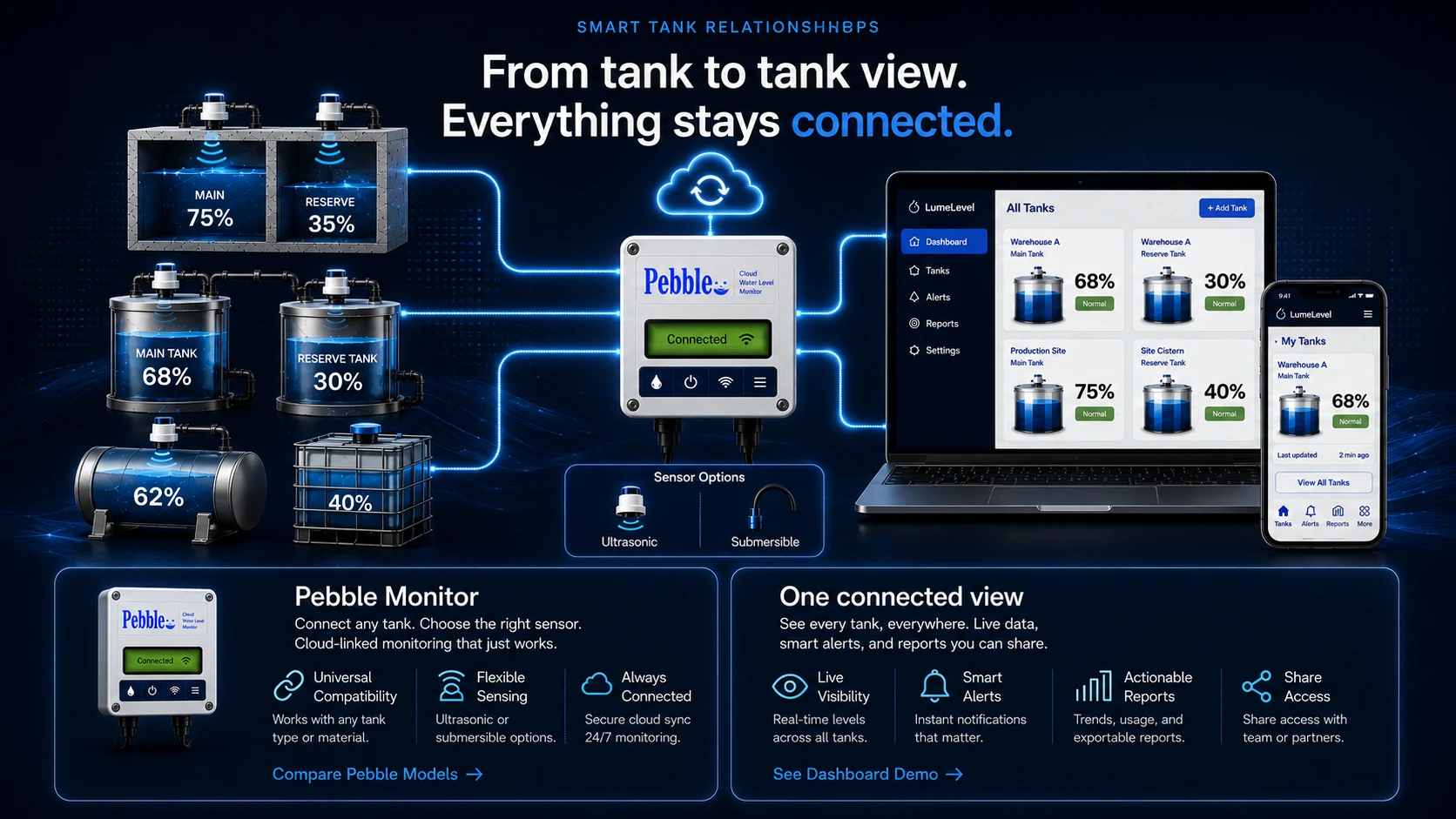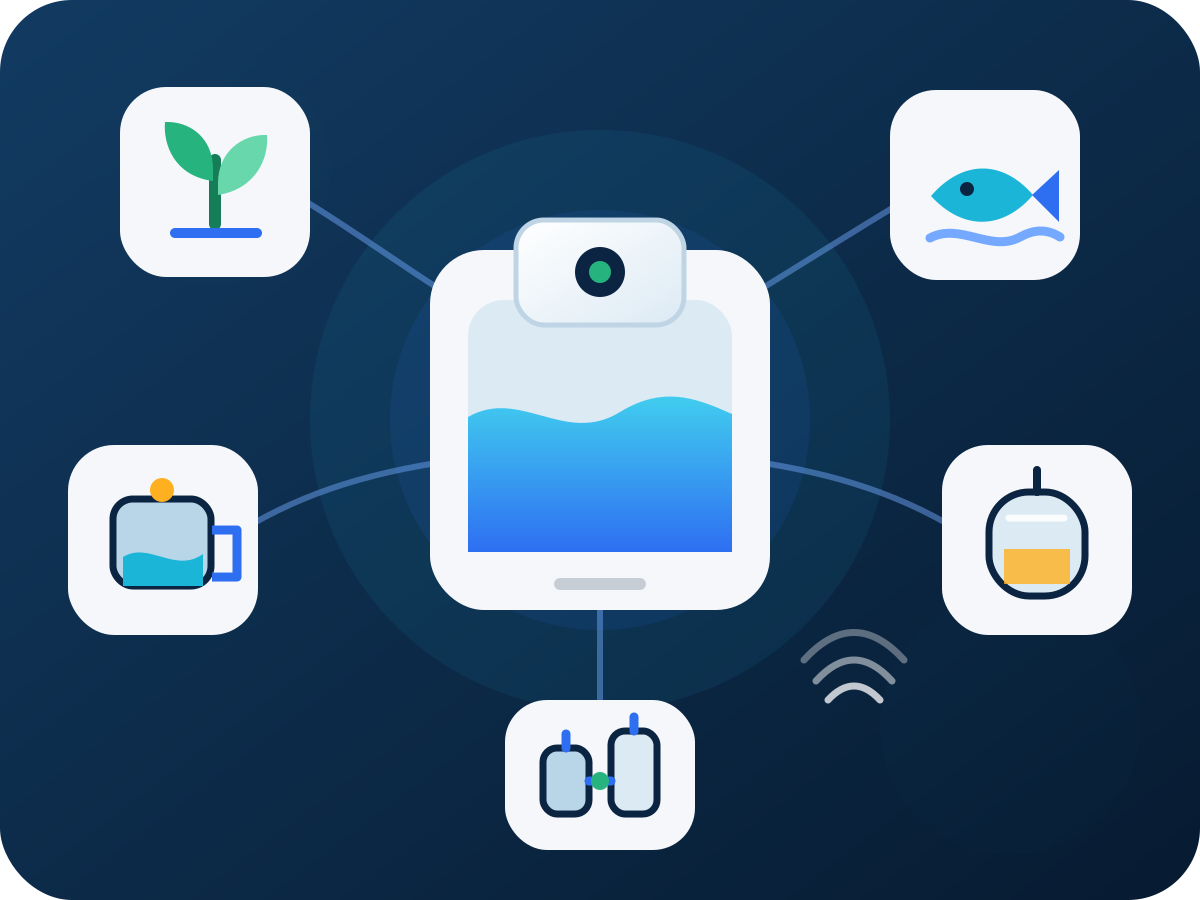
A monitored tank connected to agricultural, aquatic, sanitation, food-production, and process-fluid applications

See fluid levels sooner. Share status. Act before operations are interrupted.

LumeLevel supports practical water-tank management and selected agricultural, aquatic, sanitation, food-production, and process-fluid applications when the fluid, tank, sensor, and operating environment are suitable.

Know sooner Share safely Act early
Specialized applications

Where LumeLevel can also fit.

Beyond everyday water storage, LumeLevel may support selected agricultural, aquatic, sanitation, food-production, and compatible process-fluid applications when the tank, fluid, sensor, and operating environment are suitable.

See capacity sooner Share status safely Review application fit
Greenhouse nutrient reservoir, irrigation piping, and hydroponic growing channels
Agriculture & Hydroponics
Strong adjacent fit Agriculture, Hydroponics & Fertigation

Keep water and nutrient supply available through every growing cycle.

Hydroponic and agricultural operations depend on reservoirs, irrigation tanks, fertilizer mixes, and reserve supplies being available when needed. LumeLevel can provide level history and shared visibility so growers and operators can identify low supply before irrigation or production is interrupted.

What LumeLevel contributes
See the level Build history Share status Act before supply runs low
Possible use cases
Nutrient reservoir readiness
Confirm enough solution remains for the next irrigation or circulation cycle.
Fertigation and mixing tanks
Check volume before scheduled watering, blending, or dosing.
Reserve-water management
Watch rainwater, well water, or backup storage during dry periods.
Remote grower visibility
Give owners, managers, and field workers one shared tank record.
Application considerations: LumeLevel monitors available level or volume. It does not by itself measure nutrient concentration, pH, salinity, dissolved oxygen, or crop condition.
Aquatic system with balance tank, water-level monitoring, and aquaculture tanks
Pools & Aquaculture
Strong adjacent fit Pools, Aquaculture & Water Features

Keep level-sensitive aquatic systems within their operating range.

Pools, aquarium systems, fish tanks, ponds, and water features often depend on stable water levels, reserve tanks, sumps, or make-up water supplies. LumeLevel can help operators see level changes earlier and coordinate maintenance before low supply or excessive water loss affects operation.

What LumeLevel contributes
Level visibility Trend history Maintenance coordination Earlier investigation
Possible use cases
Pool balance and surge tanks
Monitor supporting tanks between plant-room inspections.
Make-up water reservoirs
Confirm reserve water is available for scheduled or automatic top-up.
Aquarium sumps and top-off tanks
Track sump and top-off storage used to maintain operating level.
Ponds and aquaculture tanks
Flag unusual change that may indicate overflow, evaporation, interruption, or leakage.
Application considerations: LumeLevel does not replace chlorine, pH, salinity, dissolved-oxygen, temperature, flow, or other water-quality monitoring. Wave action, aeration, foam, moving water, and sensor position must also be considered.
Holding-tank level monitoring and sanitation pump-out service planning
Wastewater & Sanitation
Non-contact sensing preferred Wastewater, Greywater & Sanitation

Plan service before a holding tank becomes an emergency.

Wastewater, greywater, and sanitation operations often depend on knowing when a holding or recovery tank is approaching its service limit. LumeLevel may help operators and service providers see capacity earlier, maintain a history, and coordinate pump-out or collection before overflow or operational disruption.

What LumeLevel contributes
See available capacity Share with service providers Build service history Act earlier
Possible use cases
Holding-tank service planning
Schedule pump-out before a high-level emergency develops.
Portable sanitation operations
Share temporary sanitation-tank status with site and service teams.
Greywater and recovery storage
Track collected water awaiting reuse, treatment, transfer, or disposal.
Remote high-level awareness
See when a tank is approaching its operating limit.
Application considerations: Non-contact sensing should be preferred where practical. Foam, condensation, vapors, sludge, solids, tank geometry, and gas accumulation can affect sensor choice and performance. Hazardous-location and confined-space requirements must be reviewed separately.
Sanitary food and beverage storage tanks with production-level visibility
Food & Beverage
Sanitary review required Food & Beverage Storage

Improve stored-volume visibility without compromising sanitary controls.

Selected food and beverage operations may benefit from remote visibility into ingredient tanks, process-water storage, day tanks, rinse-water supplies, and other supporting liquid inventories. LumeLevel may help production and maintenance teams see what is available, record level history, and coordinate replenishment.

What LumeLevel contributes
Available-volume awareness Shared status Historical records Replenishment timing
Possible use cases
Ingredient or day-tank visibility
Confirm selected stored liquids before production begins.
Process-water availability
Check supporting water for production, rinsing, or cleaning.
Production handoffs
Give operations, purchasing, and maintenance one shared level record.
Replenishment planning
Identify the next ordering, transfer, or preparation point.
Application considerations: Any installation involving consumable liquids requires review of food-contact materials, sanitary construction, cleanability, condensation, washdown exposure, enclosure suitability, and whether the sensing method touches or is isolated from the product.
Selected non-hazardous process and utility tanks with piping and monitoring
Process & Utility Fluids
Case-by-case review Selected Process & Utility Fluids

Add remote visibility to suitable non-flammable process tanks.

Some industrial and commercial operations use non-flammable, water-based, or otherwise compatible fluids stored in utility tanks, day tanks, intermediate containers, and treatment systems. Where the liquid and environment are suitable, LumeLevel may provide remote level visibility and shared operating history without replacing the facility’s process-control or safety systems.

What LumeLevel contributes
Remote status Shared visibility Inventory trend Refill or transfer timing
Possible use cases
Process-water storage
Track non-potable water used for production, cleaning, cooling, or utilities.
Selected aqueous solutions
Monitor compatible water-based liquids after materials and vapor review.
Day tanks and intermediate storage
See day tanks supplying a larger process or piece of equipment.
Treatment and dosing support tanks
Identify when a compatible feed or supporting liquid needs replenishment.
Application considerations: Every proposed fluid should be reviewed for flammability, hazardous-area classification, vapor generation, chemical compatibility, corrosion, temperature, pressure, foam, tank geometry, and enclosure requirements. Standard hardware should not be assumed suitable for fuels, volatile solvents, explosive atmospheres, or pressurized vessels.
Application qualification

The application must fit the hardware—not only the idea.

Before selecting hardware, review the fluid, tank, environment, and sensing method. This protects measurement quality, equipment life, installation safety, and the accuracy of expectations.

The fluid
Compatibility, vapor, foam, solids, temperature, corrosiveness, and flammability.
The tank
Shape, height, internal structures, pressure, access, and mounting location.
The environment
Moisture, washdown, weather, hazardous classification, and regulatory requirements.
The sensing method
Non-contact ultrasonic, RS485, analog input, or another suitably isolated measurement method.
Start with the highest-risk application

Start with the tank or fluid application creating the most risk.

Tell us about the fluid, tank, environment, and problem you are trying to prevent. We can help determine whether manual tracking, Pebble monitoring, or another supported sensing configuration is appropriate.